The Importance of Elision
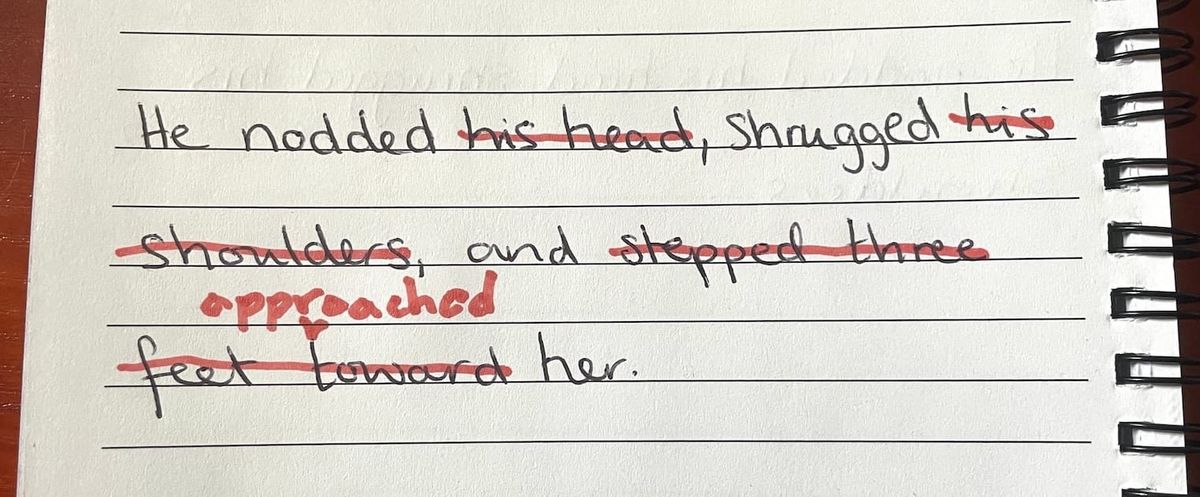
Elision (n) - the act or an instance of omitting something
Have you ever reached a climactic scene in a book where the hero reaches out to touch their lover’s face, slip a capsule of cyanide into their enemy’s glass, turn a page to reveal the secret of their niece’s paternity, and wondered . . . Wait, which hand are they doing this with? Right or left? Where is the other one? Where are their feet pointed, and which way are they looking? And why has the author not mentioned their arms?
No? Neither has any other reader. This is a writer’s problem.
It’s easy to get in your own head and imagine that if you don’t tell the reader exactly what to picture, they won’t be able to picture anything at all, or you won’t be able to convey exactly what is in your head. On the first count, you’d be wrong—one of the reasons reading is so wonderful is precisely because we get to be a part of shaping the fictional worlds we enter. It is why readers can get so upset when there’s a movie adaptation with an actor who doesn’t look like their version of the book character. All the #notmyChristian drama was not because Jamie Dornan isn’t hot. It was because people had their own visions of Christian Grey, dammit.
On the second count, rest assured—you will never be able to convey exactly what’s in your head no matter what! That’s just not how writing works. If I had never seen Taylor Swift’s face before, no amount of writing, no matter how skilled, would ever be able to convey to me exactly what she looked like.
Once you accept those two things, the reader will become your best writing partner, someone you can rely on to create worlds with you. But like with any partner, you have to trust them.
Going back to the scenario of two lovers, say you want to convey a tender moment between them. Your style may be sparer or lusher, it may include rich internality or more of an intentional remove, but when describing the basic physical act of two people touching, you will almost always find that less is more. Imagine, for example, that they are holding hands for the first time. You could write:
She reached out and grasped his right hand with her left hand.
I think we can all agree that that’s pretty terrible, right? And does it really matter which hand is grasping which? Will this help the reader see the scene more clearly in a meaningful way? Even if, in picturing this moment, the reader were to imagine our heroine standing on the other side of her lover grasping his left hand, that wouldn’t really change anything in most cases (unless he had a wooden hand or something, a la Nic Cage in Moonstruck. Then it might make the moment even tenderer). And your reader is unlikely to imagine the woman is reaching across her body for her boyfriend’s hand in some kind of sensual handshake. Readers know how people work. And how hands work.
She reached out and grasped his hand with hers is slightly better, but how many things are there that one can really grasp with? In this case, the simplest option is the best way forward:
She reached out and grasped his hand.
Authors make the mistake of providing superfluous detail in lots of contexts (and often in ways that can actually obscure meaning and make a scene harder to picture—more on that in a later post). They mention that the important relic is in the north corner of the room when neither reader nor character knows or cares about the cardinal directions in the given context. They mention the number of legs a table has (when it is just a classic tetrapod). They tell you the exact dimensions of a helicopter in feet and inches—or even better, centimeters!—when all that matters is its relative size (small, as far as hovercrafts go). But particularly, they do it when it comes to the human body in ways that are so common that it can be hard to catch in your own writing.
Most importantly, eliding the superfluous gives you room for all the other, more important stuff, the stuff unique to your characters and your voice. The stuff, in short, that makes your trusted reading partner keep reading.
*
Written by Jenny DePierre, edited by Dylan Garity